Ideology guide
Social Democracy
Welfare states, labor protections, and egalitarian reform.
Timeline
-
1860s-90s
European socialist parties form
Worker parties and unions build mass organizations around suffrage, labor rights, and socialism.
-
1914
World War I split
War votes and nationalism fracture the socialist movement.
-
1918-19
Postwar suffrage and labor reforms
After World War I, many European workers’ parties enter expanded parliamentary systems and push social insurance, union rights, and democratic reforms.
-
1930s
New Deal and Swedish model
FDR's New Deal in the US and Sweden's early folkhemmet policies show welfare-state responses to the Great Depression and rising labor militancy.
-
1942
Beveridge Report
The UK's Beveridge Report lays out a comprehensive welfare state model that later influences social democratic parties worldwide.
-
1945-70s
Welfare-state expansion
Many countries expand public healthcare, housing, education, pensions, and labor protections.
-
1980s-90s
Neoliberal pressure
Privatization and austerity challenge social democratic parties and welfare systems.
-
1990s-2000s
Third Way
Some social democratic parties (e.g., UK Labour under Blair, US Democrats under Clinton) embrace market-friendly "Third Way" policies, pulling away from traditional welfare-state expansion.
-
2020s
Renewed welfare debates
Housing, healthcare, inequality, climate jobs, and labor rights revive social democratic demands.
Modern Political Confusion
With Democratic Socialist movements stagnating in their goals to democratically vote in socialism, and economic crises continuing to devastate the lives of those living under the boom-and-bust cycles of capitalist economic systems, the appeal of Marxism-Leninism reached working-class people from other countries, and many communist parties were created with the intent of rallying the people for a mass movement which would overthrow capitalism and create a socialist state. Even in America this became very popular, and after the stock market crash of 1929, there was a wide base of support for socialism, and Marxist-Leninist tactics to achieve it, in the US and many other European countries as well. In response to this, in what is seen as a strategic retreat of the capitalist class in their power struggle over the workers, some of these governments began passing welfare policies. These welfare policies were basically safety nets, like Social Security and other publicly funded programs that help those in need.
This is where the difference in the modern, commonly accepted definitions of Democratic Socialism and Social Democracy can be explained. Democratic Socialism and Social Democracy are often confused, and can both simultaneously be represented in one government, as different people within the government will have different ideas on what the goal is. For example, two senators in the US could both identify as Democratic Socialists, but one could have the intention of actually using their vote toward an end of creating a socialist society, and the other could think the current system is fine, but that welfare reforms and public services are good, and not knowing or caring to be strict in definition, they both identify as “Democratic Socialists.”
H.G. Wells, Stalin, and the Planned Economy Debate
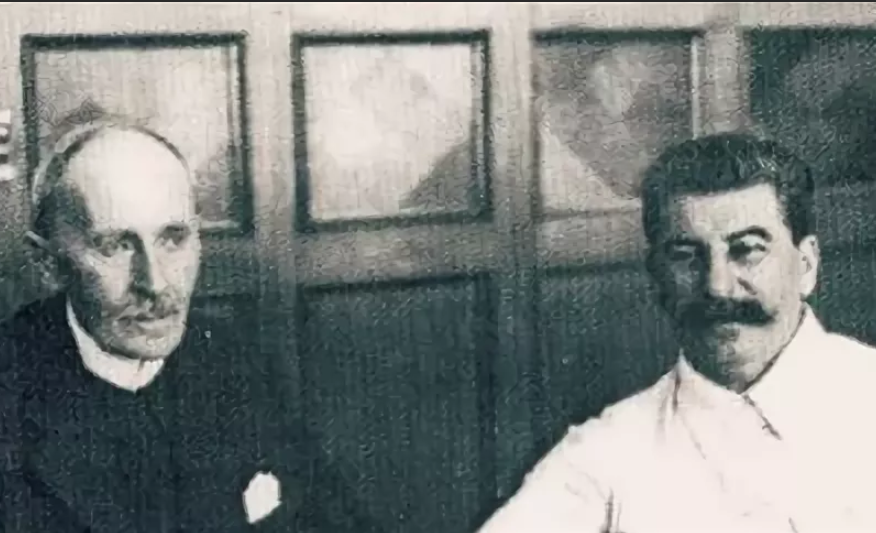
H. G. Wells, the popular British science fiction writer who wrote “The War of the Worlds” (which has now been adapted into many movies), liked to engage in public discourse on big topics in his day, and in 1934 he met with Joseph Stalin, the leader of the CPSU, to talk about this concept we have been discussing and what socialism meant. He begins the discussion with this statement:
Wells saw the social democracy that was happening under FDR’s New Deal policies and saw it as socialism itself. Trying to grapple with these two different perspectives that the USSR and the US government seemed to have on socialism, Wells posits that these movements are fundamentally the same in their aims, but only at different “starting points.” Stalin begins his reply by immediately refuting the idea and elaborating that the United States was trying to reduce the losses caused by capitalism without changing the economic basis.
Stalin argues that, at best, reforms would restrict certain excesses of capitalism rather than abolish the old social system that gives rise to anarchy and crises. He says that planned economy presupposes abolishing unemployment and increasing output in branches of industry that produce goods the masses of people particularly need, but that capitalism expands production for profit instead. Without getting rid of the capitalists, and without abolishing private property in the means of production, he argues that it is impossible to create a planned economy.
This detailed explanation of the perceived fundamental differences in the economic systems represents the development of the defined differences between them in public consciousness as a whole. In response to Stalin’s last quote, Wells tries to label this American reform as “socialism in the Anglo sense of the word,” and Stalin replies, questioning what kind of socialism this “Anglo socialism” is, giving the impression that, in the eyes of Marxist-Leninists of the time, what their government was doing was the “real” socialism.
The Modern Welfare State
Social Democracy and Democratic Socialism have continued to have support to this day, and have influenced some countries into developing what is nicknamed a “welfare state,” one where citizens have many universal public services and rights, usually including things like free or universal healthcare, free education, and other services that increase quality of life. Examples of these systems are often shown in isolation from context, abstract. They are presented as successful examples of what things could be like if we just voted for the “right policies,” ignoring the context which gave rise to these certain states, a fuller analysis of it as a whole.
While a more detailed analysis of these policies and the outcomes of these systems will be saved for the relevant chapter, it can be remarked here that Social Democracy and Democratic Socialism, in the minds of many people today, represent not only one of the two main strains of socialism, but even “socialism” itself. With the other main strain, Marxism-Leninism, being seen as “communism” by many people today who do not live in a Marxist-Leninist country, “socialism” has become a word commonly used by many to mean what, by more specific definition, would be called Democratic Socialism and/or Social Democracy. With the two main currents in contemporary socialist thought now identified, we can look deeper into the subject by examining a few more strains (of socialist thought), which arose alongside, or out of, the previously discussed two main currents.
Modern movements & current struggles
- Fight for $15 and a Union A campaign for higher wages and union rights for low-wage workers.
- National Nurses United A U.S. nurses union active in healthcare, labor, and public health campaigns.
- Public Services International A global federation of public-service unions.
- Medicare for All A U.S. campaign for a single-payer healthcare system.
- Poor People's Campaign A U.S. movement addressing poverty, systemic racism, militarism, and ecological devastation.
- International Trade Union Confederation The world's largest trade union federation, campaigning for labor rights and social protection.
Organizations
- Swedish Social Democratic Party Sweden
- Labour Party United Kingdom
- Australian Labor Party Australia
- Social Democratic Party of Germany Germany
- Socialist Party France
- New Zealand Labour Party New Zealand
- Socialist International Global